
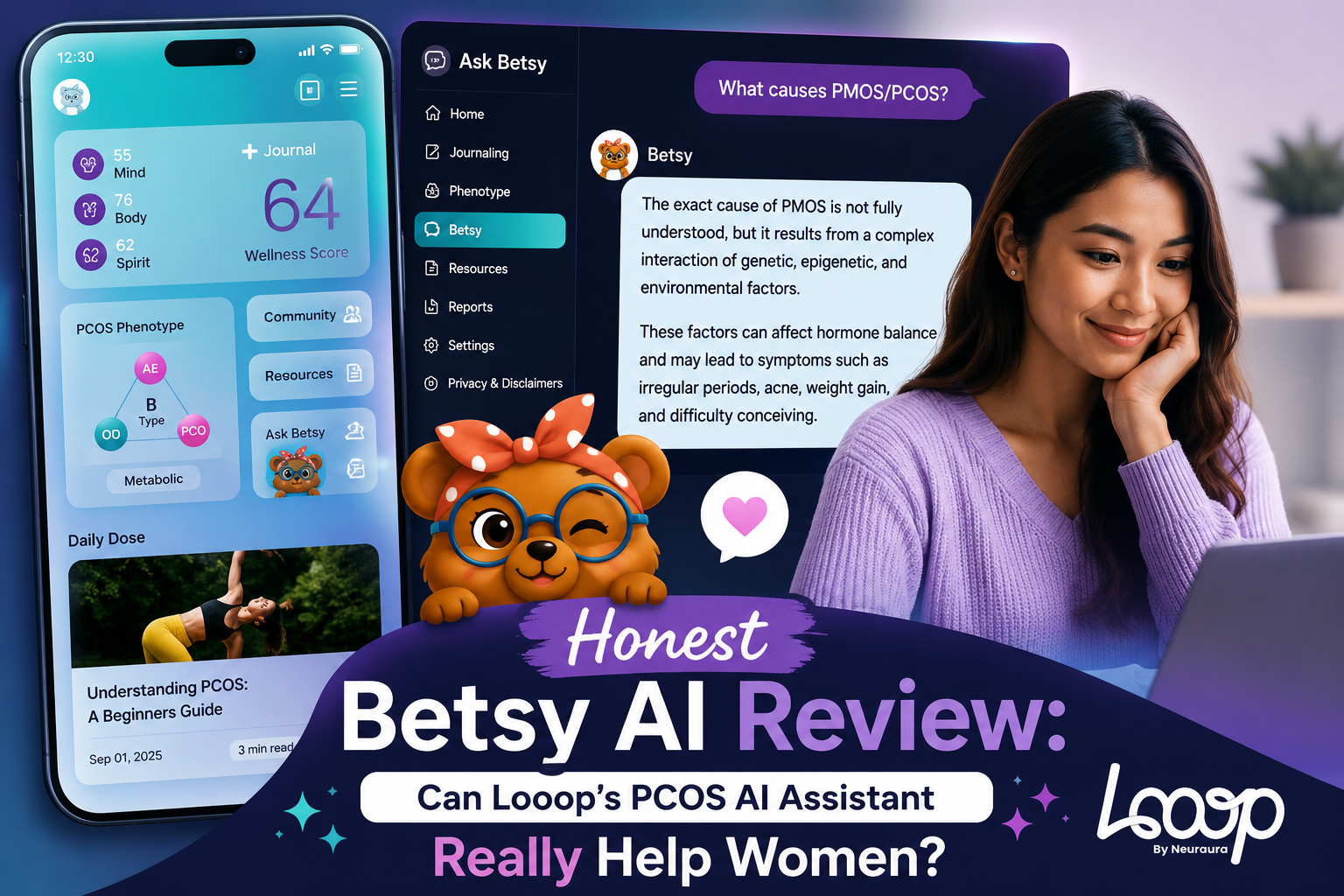
Betsy AI Review – Transparency Note: I was invited to join LoOoP’s End-User Advisory Board and received early beta access to test Betsy AI before its wider release. This review is not sponsored, and LoOoP did not review or approve this article before publication. Every opinion shared here reflects my personal experience using the platform and is intended to provide honest, balanced feedback that helps women living with PCOS while also offering constructive insights to the LoOoP team.
Betsy AI Review: Can Artificial Intelligence Really Help Women with PCOS?
Artificial intelligence is changing almost every part of our lives, including healthcare.
From symptom checkers to personalized health insights, AI is becoming another tool that people use to better understand their health before, during, and after speaking with a healthcare professional. For women living with Polycystic Ovary Syndrome (PCOS), that possibility is especially exciting.
PCOS is one of the most common hormonal disorders affecting women of reproductive age, yet many still struggle to access clear, reliable, and easy to understand information.
A diagnosis often raises more questions than answers. Why are my periods irregular? Will I be able to have children? Why am I gaining weight even when I’m trying my best? What should I eat? Is this symptom normal?
As the founder of PCOS Millennials, these are questions I hear every week from women in the Philippines and from our growing community around the world.
That’s why I was genuinely interested when I had the opportunity to test Betsy, the AI assistant developed by LoOoP. Instead of treating this as a quick product review, I wanted to experience it the way an actual user would. Not as someone trying to find bugs.
Not as someone looking for reasons to praise it but as a woman living with PCOS who understands how overwhelming this condition can be.

My Journey with LoOoP
This isn’t my first time writing about LoOoP.
Over the past several months, I’ve shared updates with our community as I watched the platform evolve from an exciting idea into something women could actually use. Now, being part of LoOoP’s End-User Advisory Board has given me the opportunity to see that journey from a different perspective.
Rather than simply reading about new features, I was able to test them before wider release and provide honest feedback based on real conversations. I believe transparency matters.
Whenever someone reviews a product, readers deserve to know the relationship between the reviewer and the company. That’s why I want to make one thing clear. Being part of an advisory board doesn’t mean every opinion is automatically positive.
In fact, the purpose of an advisory board is to identify strengths, highlight weaknesses, and help improve the experience for future users.
That’s exactly what this review aims to do.
How I Tested Betsy AI
I didn’t ask Betsy only simple questions like: “What is PCOS?”
Instead, I designed conversations around situations that many women actually experience. During my testing, I evaluated how Betsy handled:
- PCOS education
- Fertility concerns
- Follow-up conversations
- Emotional support
- Medical safety
- Multilingual communication
- Personalization
- Overall usability
I wanted to know one thing.
Could Betsy become the kind of companion that helps women feel less alone while navigating PCOS? After several conversations, I came away with a balanced impression. There are many things Betsy already does remarkably well.
There are also areas where I believe it can become even stronger.
Overall Rating
| Category | Rating |
|---|---|
| Medical Knowledge | ⭐⭐⭐⭐⭐ |
| User Experience | ⭐⭐⭐⭐☆ |
| Interface Design | ⭐⭐⭐☆☆ |
| Empathy | ⭐⭐⭐⭐☆ |
| Follow-up Conversations | ⭐⭐⭐⭐☆ |
| Personalization | ⭐⭐⭐⭐☆ |
| Accessibility | ⭐⭐☆☆☆ |
| Global Readiness | ⭐⭐⭐☆☆ |
Overall Rating: 4.2 out of 5
For a specialized women’s health AI, that’s an impressive starting point.

What Betsy Does Exceptionally Well
1. Betsy Knows Its Purpose
One of the biggest strengths I noticed is focus.
Unlike general AI assistants that attempt to answer nearly every question imaginable, Betsy has a clear mission. It exists to educate and support women living with PCOS and PMOS.
That focus becomes obvious almost immediately.
The conversations consistently stayed within the topic. The information felt grounded in evidence rather than opinion. Instead of trying to become everything for everyone, Betsy concentrates on doing one job well.
In healthcare, that kind of specialization builds confidence.
2. Medical Safety Comes First
This was something I genuinely appreciated.
Healthcare AI carries an enormous responsibility. Giving the wrong advice could have serious consequences. Throughout my conversations, Betsy remained careful with its recommendations.
Rather than diagnosing conditions or suggesting medications, it regularly encouraged consultation with qualified healthcare professionals.
That isn’t a weakness. It’s exactly what responsible health technology should do. AI should educate. Doctors should diagnose.
Keeping those roles separate helps create a safer experience for everyone.
3. The Conversations Feel Encouraging
Another pleasant surprise was Betsy’s conversational style.
Instead of ending every answer with a wall of information, it often invited me to continue. Questions like: “Would you like to know more?” or “Which aspect would you like to explore?” made the interaction feel more natural.
Healthcare conversations shouldn’t feel like reading a textbook. They should feel supportive.
Betsy moves in that direction.
4. Complex Topics Become Easier to Understand
Medical terminology can intimidate anyone.
When I intentionally asked Betsy to explain certain concepts more clearly, I noticed that it adapted well. Instead of repeating the same explanation, it simplified medical ideas using more approachable language. One example involved explaining how PCOS is diagnosed.
Rather than overwhelming users with technical language, the explanation became much easier to follow.
That’s especially important for women who have just received a diagnosis and may already feel anxious. Good health education isn’t about using impressive vocabulary.
It’s about helping people understand.

The Areas That Still Need Improvement
Every product has room to grow.
Betsy is no exception. During my testing, several opportunities became clear.
The encouraging part is that many of these improvements feel achievable.
Language Accessibility Matters
As someone based in the Philippines, this became my biggest observation.
When I asked Betsy whether it could communicate in Tagalog, the answer was simple. It currently communicates only in English. While English works well for many users, millions of women around the world naturally seek health information in their first language.
For someone already feeling vulnerable after a diagnosis, language should never become another barrier.
Imagine opening the app and seeing: “Hello! I can help you in English or Tagalog.” That small change could immediately make the experience feel warmer and more welcoming.
The same idea applies beyond the Philippines.
Women across Asia, Latin America, Europe, and the Middle East would benefit from broader language support as LoOoP continues to expand globally. Accessibility isn’t only about technology.
Sometimes it’s about speaking someone’s language.
Conversations Should Feel More Natural
One moment during my testing stood out.
After Betsy asked whether I’d like to discuss a specific aspect of PCOS, I responded with a simple follow-up question asking what it meant. Instead of recognizing that I was asking for clarification, the AI interpreted my response differently. It wasn’t a major issue.
But conversations depend on context.
The more naturally an AI understands follow-up questions, the more comfortable users will feel asking sensitive health concerns without worrying about phrasing every question perfectly.
Information Can Sometimes Feel Overwhelming
Women newly diagnosed with PCOS are often scared.
They’re searching for reassurance. Receiving several long paragraphs at once may unintentionally increase that feeling of overwhelm. Personally, I’d love to see more layered information. Start with a short summary.
Then provide an option to explore additional details.
That approach gives users more control over their learning journey while making complex information easier to digest.
Looking Ahead
Despite these observations, I want to emphasize something important.
None of these improvements take away from the value Betsy already provides. In fact, they show how close the platform is to becoming something even more impactful. When I finished testing, my overall impression wasn’t that Betsy needed to start over.
It was that Betsy already has a strong foundation and now has an exciting opportunity to evolve into an even more inclusive, personalized, and globally accessible companion for women living with PCOS.
Betsy already has a strong foundation. Now I’d like to focus on something equally important. What could make the experience even better?
As someone who has lived with PCOS, built PCOS Millennials, and speaks with women from different backgrounds almost every day, I naturally viewed Betsy through the eyes of the women who may one day rely on it for guidance.
Not just women in North America or Europe. But women in the Philippines. Across Asia.
And eventually, around the world.

A Clean Interface That Feels Calm
The first thing I noticed when using Betsy was the overall design.
It feels modern, uncluttered, and easy to navigate. In healthcare, that’s more important than many people realize. Women who are searching for answers are often already overwhelmed.
A complicated interface only adds to that stress.
LoOoP has done a good job creating an environment that feels calm rather than intimidating. The dark theme also gives the app a polished, premium feel. It encourages users to slow down and focus on the conversation.
That said, I did notice one area where the experience could be improved.

Readability Matters More Than We Think
While I personally like dark mode, the typing area felt darker than the rest of the interface.
The contrast between the background and the text could be stronger. When typing longer questions, I occasionally found myself paying more attention to the text box than to what I wanted to say. It’s a small design detail.
But small details shape everyday experiences.
A slightly brighter input field and improved text contrast would make writing feel more comfortable, especially during longer conversations.
More Choice Is Always Better
One feature I’d love to see is the ability to switch between different appearance modes.
Not everyone enjoys dark mode. Many women prefer softer color palettes that feel warm and welcoming. Imagine being able to choose between:
- Dark Mode
- Light Mode
- System Default
Even subtle color options inspired by women’s health branding, such as soft pink, lavender, sage green, or cream, could make the experience feel more personal without becoming distracting.
Accessibility isn’t just about functionality.
It’s also about helping people feel comfortable using the product every day.

The Biggest Opportunity: Language
If there’s one improvement I hope eventually becomes a priority, it’s multilingual support.
This observation came directly from my testing.
When I asked Betsy whether it understood Tagalog, it explained that it currently communicates only in English. There’s nothing wrong with supporting English first. Every product has to start somewhere but if LoOoP hopes to become a truly global platform for women’s health, language will play a huge role.
Here in the Philippines, many women understand English.
But understanding English isn’t the same as feeling emotionally comfortable discussing deeply personal health concerns in English. Health conversations are different. People naturally return to the language they think and feel in.
Imagine opening the app and simply seeing:
“Hello! I can help you in English or Tagalog.”
That small moment instantly makes the experience feel more welcoming.
The same applies to users speaking Bahasa Indonesia, Thai, Vietnamese, Japanese, Korean, Spanish, Portuguese, Arabic, French, German, and many other languages.
Women’s health is universal.
Access to understandable health information should be too.

AI Should Remember the Journey
One feature I believe would make Betsy significantly more valuable is memory.
Not memory in the sense of storing unnecessary information. But remembering meaningful health context. For example:
A user shares that she’s 29 years old. She’s trying to conceive. She has irregular cycles. She experiences acne. Her BMI is above 30.
The next time she returns, imagine Betsy saying:
“Welcome back. Last time we discussed irregular cycles while trying to conceive. How have things been since then?” That single sentence changes everything.
Instead of feeling like another chatbot, Betsy begins to feel like a companion following someone’s health journey over time.
Of course, this should always be transparent and under the user’s control, with privacy and consent at the center of the experience.

Personalization Creates Trust
Closely connected to memory is personalization.
During my conversations, Betsy responded appropriately based on the information I provided. But I also saw opportunities to make responses feel even more tailored. Rather than offering only general information, Betsy could occasionally connect advice back to details the user has already shared.
For example:
“Because you’re trying to conceive…”
“Since your BMI is above 30…”
“Based on your irregular menstrual cycles…”
Small adjustments like these help users feel understood instead of simply informed.
Imagine If Betsy Could Do Even More
One of the exciting things about AI is that it doesn’t have to stop at answering questions.
Over time, I’d love to see Betsy evolve into a more complete women’s health companion. As someone from the Philippines, I especially appreciate the idea of meal suggestions based on foods women actually eat every day. Instead of generic recommendations, imagine practical guidance using rice, fish, vegetables, tofu, mung beans, or other familiar local ingredients.
Health advice becomes far more useful when it fits real life.

Why AI Will Never Replace Doctors
One thing I want to make absolutely clear is this:
I don’t believe AI should replace healthcare professionals and after using Betsy, I don’t believe that’s LoOoP’s goal either. Throughout my conversations, Betsy consistently encouraged users to consult qualified healthcare providers whenever appropriate.
That’s exactly the balance I hope continues as the platform evolves.
The future isn’t AI instead of doctors. The future is AI helping patients become more informed before they walk into the consultation room. A woman who better understands her symptoms often feels more confident asking questions, understanding treatment options, and participating in decisions about her own care.
That’s where I believe AI has tremendous potential.

Betsy AI and ChatGPT Aren’t Competitors
People often compare every new AI product to ChatGPT.
After testing Betsy, I don’t think that’s the right comparison. They’re designed for different purposes. ChatGPT is a general-purpose AI capable of discussing almost any topic imaginable.
Betsy was built with a much more focused mission.
Helping women better understand PCOS and PMOS. That specialization allows the platform to provide a more consistent educational experience within its intended scope.
Rather than competing, I see tools like Betsy and ChatGPT contributing to a broader ecosystem where different AI assistants solve different problems.

A Great Way for Women to Experience Betsy
One thing I appreciate is that LoOoP has made it easier for first-time users to explore the platform.
At the time of writing, the company offers a public first-month free trial for new users, along with an annual subscription option that provides additional value for those planning to use the platform long term. I think that’s a smart approach. Healthcare technology is personal.
Giving women an opportunity to experience the platform before committing helps build confidence and trust.
My Final Thoughts
After spending time testing Betsy, I walked away feeling genuinely encouraged.
Not because I think the platform is perfect. No technology is. What stood out to me was the clear purpose behind it.
LoOoP isn’t trying to build just another AI chatbot. It’s building a dedicated companion designed to help women better understand PCOS through evidence-based education, thoughtful conversations, and a supportive user experience. In a world where misinformation about women’s health is still common, that mission matters.
As someone living with PCOS and as the founder of PCOS Millennials, I know how lonely this journey can sometimes feel. Many women leave a doctor’s appointment with more questions than answers. Others spend hours searching online, only to find conflicting information that leaves them even more confused.
Sometimes what we need isn’t another article or another social media post.
Sometimes we simply need a safe, judgment-free space where we can ask questions, better understand our condition, and feel empowered to have more informed conversations with our healthcare providers.
That’s where I believe Betsy has real potential.
My feedback throughout this review isn’t about finding faults. It’s about recognizing opportunities. Expanding multilingual support, improving personalization, enhancing conversational flow, and introducing more interactive health tools could make Betsy even more valuable for women across different countries, cultures, and languages.
If LoOoP continues listening to its community and evolving with users’ needs, I genuinely believe Betsy has the potential to become one of the most trusted AI companions for women’s health.
Thinking of Trying LoOoP?
If you’re curious about experiencing Betsy for yourself, LoOoP currently offers a public first-month free trial for first-time users.
- First Month Free Trial:
LOOOPTRIAL - Annual Plan (12 months for the price of 11):
LOOOPANNUAL
And if you’re part of the PCOS Millennials community, you can also use our community code: LOOOPEARLY
This public code provides discounted access and is a great way to support both your own PCOS journey and our growing community.
Take Free Insulin Resistance Test

Take Free PCOS/PMOS Test

Take Free Fertility and Ovulation Test

Free January–December 2026 Devotional eBook from PCOS Millennials

Free eBook for Every Millennial Woman with PCOS: Your Ultimate Guide to Thriving with Hormonal Imbalance



Leave a Reply