
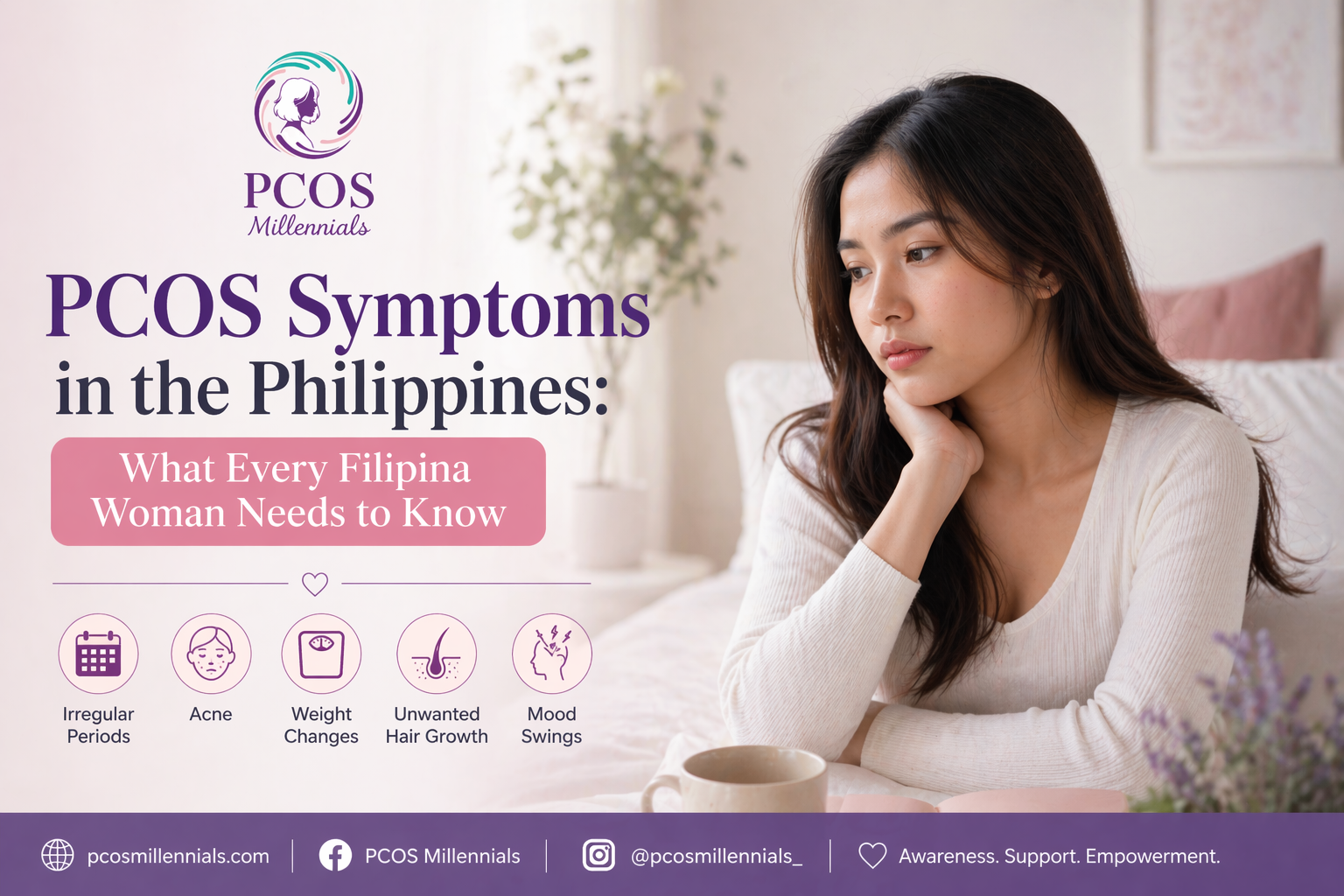
Discover PCOS symptoms Philippines—common signs in Filipina women, causes, emotional impact, and when to seek proper diagnosis and support.
When Your Body Starts Telling You Something Is Wrong
PCOS symptoms Philippines are often misunderstood, especially among Filipina women who experience changes in their bodies without clear answers. From irregular periods to hormonal acne, these symptoms can appear slowly and are often dismissed—until they begin to affect daily life.
There are moments when your body begins to change and you notice it, but you cannot fully explain it.
Hindi naman siya biglaan. Hindi rin siya dramatic. But little by little, something feels different. Maybe your period starts becoming irregular. Not just delayed once, but consistently unpredictable.
There are months when it comes late, and there are months when it doesn’t come at all. At first, you brush it off.
You tell yourself it’s just stress. But deep inside, you begin to wonder if there is something more.
Then come the other signs. Acne that refuses to go away, even when you’ve already tried everything. Not the usual pimples—but the kind that stays, that comes back, that settles around your jawline as if it belongs there.
This is how many PCOS symptoms in the Philippines begin—quiet, gradual, and easy to ignore until they’re not.

Understanding PCOS Symptoms Beyond the Surface
When we talk about PCOS symptoms Philippines, most people focus on the physical. The visible signs. The ones that can easily be explained—or judged.
But PCOS symptoms are not just surface-level changes. They reflect deeper hormonal imbalances happening inside the body.
Irregular periods, for example, are not just an inconvenience. They are often a sign that ovulation is not happening regularly. And when ovulation becomes inconsistent, it affects not just fertility—but the entire hormonal cycle of a woman.
The same goes for acne. It is not always about skincare. Many women spend years trying different products, routines, and treatments—without realizing that the root cause is hormonal.

The Visible Signs That Are Often Misunderstood
One of the most noticeable symptoms of PCOS is unwanted hair growth (hirsutism). For many Filipina women, this can feel uncomfortable and even embarrassing.
Hair appearing on the upper lip, chin, or other areas is often linked to increased androgen levels.
Another commonly overlooked sign is the darkening of the skin in areas like the neck, underarms, or inner thighs. This condition, known as acanthosis nigricans, is often associated with insulin resistance.
These are not random issues—they are connected signs of a deeper hormonal imbalance.

When Symptoms Start Affecting Your Confidence
Beyond the physical changes, there is something deeper that many women experience—but rarely talk about.
The emotional impact.
Because when your body changes in ways you don’t understand, it affects how you see yourself.
Acne becomes more than just a skin issue—it affects your confidence. Hair growth becomes something you try to hide. Weight changes become something people comment on.
In the Philippines, where beauty standards are often emphasized, these changes can feel even heavier.
Many women carry this silently.

Symptoms That You Feel But Others Don’t See
Not all PCOS symptoms Philippines can be seen.
Fatigue is one of the most common but overlooked symptoms. It’s not just being tired—it’s a deep exhaustion that doesn’t go away with rest.
There are also mood changes, anxiety, and emotional sensitivity.
Because these symptoms are invisible, they are often misunderstood.
But they are real—and they matter.

Why PCOS Symptoms Are Often Ignored
One of the biggest challenges with PCOS symptoms in the Philippines is that they are often normalized.
Irregular periods are sometimes dismissed as “okay lang yan.” Acne is treated as a temporary issue. Weight changes are blamed on lifestyle alone.
And because of this, many women delay seeking help.
Not because they don’t care—but because they are not aware that what they are experiencing could be connected.
There is also hesitation. Fear of being judged. Fear of being told that it’s nothing serious. Or fear of finding out that it is something more.
So instead of asking questions, many choose to wait.
But PCOS is not something that should be ignored. Because the earlier you understand it, the better you can respond to it.

The Importance of Proper Diagnosis
PCOS symptoms alone are not enough to confirm the condition.
Diagnosis usually involves symptoms, hormone tests, and ultrasound findings. Doctors often follow the “2 out of 3 rule” before confirming PCOS.
This is why proper medical consultation is important.
According to the World Health Organization, PCOS is one of the most common hormonal disorders affecting women worldwide.
👉 https://www.who.int/news-room/fact-sheets/detail/polycystic-ovary-syndrome

Living With PCOS Symptoms in Everyday Life
Living with PCOS symptoms Philippines means navigating daily challenges—physically, emotionally, and mentally.
Some days feel manageable. Others don’t.
And that’s okay.
Understanding your body is not about perfection—it’s about awareness.

You Are Not Alone
If you recognize these PCOS symptoms Philippines, know this:
You are not imagining things.
You are not overreacting.
And you are not alone.
Many Filipina women are going through the same experience.

Final Thoughts: Listening to Your Body Matters
PCOS symptoms are your body’s way of communicating something deeper.
They are not there to confuse you—but to guide you.
You deserve clarity.
You deserve support.
And most of all—
👉 You deserve to understand your own body. 💛
Free January–December 2026 Devotional eBook from PCOS Millennials

Free eBook for Every Millennial Woman with PCOS: Your Ultimate Guide to Thriving with Hormonal Imbalance





Leave a Reply